

Knowing your hair's porosity: essential
Have you ever heard of hair porosity?
Just like hair's nature, type, and texture, porosity is an indicator to consider for hair care.
Discover your hair's porosity level now and how it influences your hair care routine.
What is "hair porosity"?

The hair's cuticles (its small scales that allow it to absorb the benefits of nutrition and hydration) define, based on their openness, the hair's porosity.
Curly, coily, frizzy, and wavy hair is generally more porous than straight hair, because its cuticles are more open at the curl.
Hair porosity is not fixed and can change over time depending on the care habits adopted.
The hair's porosity level can be identified simply by observing how the hair reacts to moisture.
The 3 levels of hair porosity:
|
Low porosity
(dense, tight, closed scales) |
Medium porosity
(open, normal scales) |
High porosity
(overly open, damaged scales) |
|
The scales do not (or very rarely) allow moisture to pass through |
The scales allow moisture to pass through optimally |
The scales do not retain moisture |
What are the factors influencing porosity?
- Hair type, texture, and nature
- Treatments used (chemical products, colorings, relaxers...)
- Use of heating tools (hair dryer, straightener...)
- Eating habits
- Hair brushing
The importance of knowing your hair's porosity

Hydration is a key step in maintaining hair health.
Defining your hair's porosity helps to better understand its hydration needs and thus adopt an adapted hair routine.
This allows you to know which types of products to use (depending on the ingredients and the texture of the treatment) and to adopt the right maintenance practices to optimize the essential hydration level for your hair, in the long term.
Depending on whether it is low, medium or high, hair porosity is not maintained in the same way. Here are MakeMyMask tips and the 3 natural routines to adopt to take care of your scalp and lengths!
Low porosity hair
Low porosity hair tends to take a long time to get wet, has a relatively long drying time, is easily greasy/oily, and quickly becomes "hard" or "heavy" after using certain products.
Their scales are often very dense, tight, and closed. The goal is to open the scales to allow proper hydration penetration.
Our tips to know:
- Prefer a routine composed of "light" treatments and avoid protein treatments
- Wash your hair with lukewarm or hot water to open the scales
- Use a treatment cap or a hot towel during treatment application
- Seal hydration with a fine and light vegetable oil
Special routine for low porosity hair
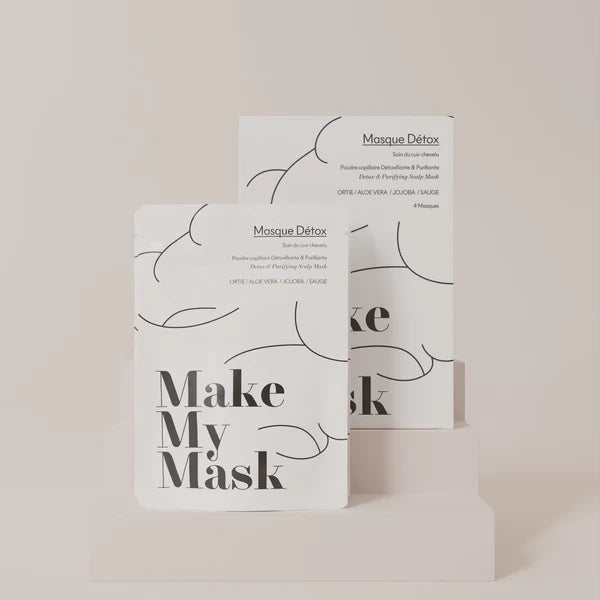


| Detox Cure | Gentle Natural Shampoo | Treatment Cap |
|
To regulate sebum production |
To rinse masks and gently wash hair |
To increase the effectiveness of the care provided |
Medium porosity hair
Medium porosity hair retains moisture well: hydrating treatments penetrate naturally and easily into the hair fiber.
The scales are open enough to allow moisture to pass through. The goal is to maintain your current care habits and hair quality.
What to do:
- Continue current treatments regularly because they work well!
- Medium hair porosity does not impose any particular restrictions to take into account for your routine
- If the porosity level changes over time, adapt your routine depending on whether the hair becomes more or less porous
Special routine for normal porosity hair


| Volume Treatment | Natural Gentle Shampoo | Natural Detangling Balm |
|
To add volume to fine hair |
To rinse masks and gently wash hair |
To deeply nourish and repair hair |
Highly porous hair
Highly porous hair is often dull and brittle. It remains dry and rough, even after being hydrated, tangles easily, and tends to frizz in humid conditions.
Hair treated with chemicals, accustomed to hairdryers or straighteners, often has high porosity.
Their cuticles are too damaged and open, not retaining enough hydration.The goal is therefore to close the hair cuticles so that it can retain water.
Our tips to know:
- Perform treatments such as oil baths, plant powder masks, protein masks, etc.
- Wash hair with lukewarm water and rinse with cold water with an acidic rinse water (water + lemon or vinegar)
- Avoid heat sources and prefer natural drying or cold air drying
- Seal in moisture with a thicker vegetable oil
Special routine for highly porous hair

| Beauty Treatment | Natural Gentle Shampoo | Natural Detangling Balm |
|
To beautify and strengthen hair |
To rinse masks and gently wash hair |
To deeply nourish and repair hair |


