Hormonal hair loss, also known as androgenetic alopecia, affects millions of women and men. One of the most effective ways to slow its progression is to use a DHT Blocker, a supplement capable of targeting the underlying hormonal cause of the problem. Here's everything you need to know to understand how it works, who it's for, and what results to expect.
What causes hormonal hair loss?
Hormonal hair loss is caused by a hormone called DHT (dihydrotestosterone), produced from testosterone by an enzyme: 5α-reductase. When DHT is present in excess, it progressively attacks the hair follicles, making them smaller (called miniaturization), which shortens the growth phase of the hair and prolongs the resting phase. The result is that hair falls out faster than it grows back.
This hair loss is common in men (baldness), but also in women, especially in cases of PCOS (polycystic ovary syndrome) or during menopause.

Hormonal hair loss vs. reactive hair loss: what's the difference?
It is essential to distinguish between hormonal and reactive hair loss, as the causes – and therefore the solutions – are not the same:
-
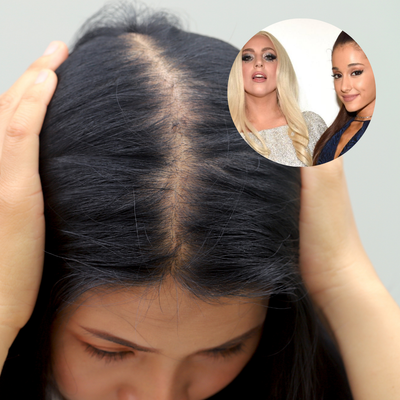
Hormonal hair loss (androgenetic alopecia): chronic, slow, localized (often at the top of the head or the central parting), with hair progressively thinning.
-
Reactive hair loss: sudden, diffuse over the entire scalp, often triggered by intense stress, a change of season, significant fatigue, or childbirth (postpartum). It is temporary, but more noticeable.

How does a DHT Blocker work?
The DHT Blocker is a supplement that acts directly on the 5α-reductase enzyme, responsible for DHT formation. By blocking this enzyme, it helps to reduce DHT levels in the scalp, and thus to:
-
limit follicle miniaturization,
-
slow progressive hair loss,
-
promote stronger and denser regrowth.

At MakeMyMask, our DHT Blocker is part of a comprehensive anti-hormonal hair loss protocol with pre-shampoo, shampoo & DHT Blocker for a targeted, natural, and truly effective solution.

What about advanced androgenetic alopecia?
Even if the results are more visible when acting at the first signs, our DHT Blocker can also stabilize hair loss in more advanced cases. It helps to preserve remaining hair, slow the progression of alopecia, and improve overall scalp density, provided it is combined with a complete and adapted routine.
Natural DHT Blocker vs. Medicinal Treatments: What's the Difference?
Medications like finasteride or dutasteride are effective, but can cause severe side effects: libido problems, decreased fertility, hormonal imbalances.
Our natural DHT Blocker has a gentler action and is much better tolerated, with no undesirable side effects. It also contains probiotics, which increase its bioavailability (better absorption) and support intestinal microbiome balance.
How long does it take to see effects?
Generally, the first results appear between 45 and 90 days:
-
hair loss gradually slows down,
-
hair density improves,
-
hair appears stronger and thicker.
To maintain these effects, it is important to continue the treatment long-term: regularity is what yields lasting results.
In conclusion
Hormonal hair loss is linked to an excess of DHT. Our DHT Blocker works by blocking the enzyme responsible for its production. It is a natural and well-tolerated alternative to medication. The first effects appear within 6 to 12 weeks, but a complete & continuous protocol is essential for lasting results.

➡️ Want to try our DHT Blocker? Discover our 100% natural Hormonal Hair Loss Protocol, clinically supported & developed by a Doctor of Pharmacy & Trichologist!