Do you notice flakes on your scalp: persistent dandruff, itching, red patches? Many people confuse dandruff with scalp psoriasis. However, these are not the same conditions, and their management differs entirely. In this article, we will see how to easily distinguish them, what the key symptoms are, and above all, what solutions to adopt to restore a healthy scalp.
Dandruff: dry or oily?
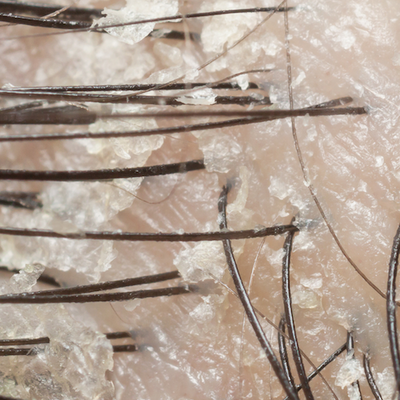
Dandruff appears when the skin of the scalp renews itself too quickly. They are not all identical: we distinguish between dry dandruff and oily dandruff, whose origins and appearance are very different.
Dry dandruff
They appear as small, fine, white particles, similar to dust, that easily fall onto the shoulders. The scalp is dry, sensitive, sometimes slightly irritated but without significant redness.
They are often linked to dehydration, the use of overly aggressive hair products, stress, or even winter cold.
Oily dandruff
They are thicker, yellowish, and stick to the scalp. They are almost always associated with significant itching and redness. Their main cause is seborrheic dermatitis, a condition linked to the proliferation of a fungus naturally present on our skin: Malassezia.
When the scalp produces too much sebum, this fungus feeds on these lipids and produces irritating substances. The result: inflammation, oily flakes, and persistent itching.

Scalp Psoriasis: very different patches
Psoriasis is an autoimmune inflammatory disease. Here, it is not sebum or a fungus that is responsible, but an excessive reaction of the immune system.
Specifically, the skin produces cells much too quickly (up to 7 times faster than normal), which leads to the formation of thick, dry red patches, well-defined, often covered with silvery scales.
These patches frequently appear on the edges of the scalp (temples, nape of the neck, behind the ears) and cause sometimes intense itching, even leading to bleeding from scratching. Unlike dandruff, psoriasis is a chronic disease: it cannot be cured, but it can be controlled and stabilized long-term.

Comparison table: dandruff or psoriasis?

How to differentiate?
-
Dandruff is generally diffuse, in the form of small, dry or oily flakes. They disappear with appropriate care.
-
Psoriasis, on the other hand, forms thick, well-defined, chronic, and recurring patches.
⚠ Even dermatologists can sometimes hesitate at first glance. This is why a personalized dermo-capillary diagnosis is essential to adapt the management.
What natural solutions to adopt?
In case of dandruff
-
Use a purifying pre-shampoo that helps to loosen flakes (e.g.,: Anti-Dandruff Pre-Shampoo Mask).
-
Wash with a gentle pH5 antifungal shampoo, which targets Malassezia without irritating the scalp.
Soothe with a hydrating serum with aloe vera or hyaluronic acid.
In case of psoriasis
-
Apply a gentle keratolytic treatment (like the Anti-PSO & Patches Concentrate) to help eliminate plaques without irritation.
-
Use a gentle pH5 sulfate-free shampoo, respecting the microbiome (e.g.,: pH5 Universal Shampoo).
-
Soothe with a hydrating serum enriched with prebiotics to calm inflammation.
Support internal balance with anti-inflammatory supplements (omega-3, vitamin D, turmeric, zinc).
Link to our guide for soothing scalp psoriasis

Preventing recurrence: microbiome, diet, and lifestyle
Whether it's dandruff or psoriasis, the key is to work on the underlying factors:
-
Preserving the microbiome: choose pH5 shampoos, enriched with prebiotics.
-
Anti-inflammatory diet: favor omega-3s, colorful vegetables, turmeric; limit sugar, alcohol, and ultra-processed foods.
-
Stress management: yoga, cardiac coherence, meditation. Stress is a major trigger.
Restorative sleep: essential for skin and immune balance.
FAQ
Can psoriasis disappear permanently?
No, it is a chronic disease. But an adapted routine can significantly reduce flare-ups.
Is dandruff contagious?
No. Neither dandruff nor psoriasis is contagious.
Does scratching patches make the situation worse?
Yes, scratching increases inflammation and can even cause localized scarring alopecia.
Why doesn't my conventional anti-dandruff shampoo work?
Many shampoos contain irritating sulfates. They mask symptoms without treating underlying causes like the microbiome.
Conclusion
Differentiating between dandruff and psoriasis is essential to adopting the right routine. Dandruff, whether dry or oily, is well controlled with gentle and targeted care. Psoriasis, on the other hand, requires a global approach that combines local care, supplements, and lifestyle. In all cases, a microbiome-friendly routine helps to soothe the scalp and limit recurrences.
👉 Not sure where to start? Get your free dermo-capillary diagnosis here and discover the most suitable routine for your scalp.